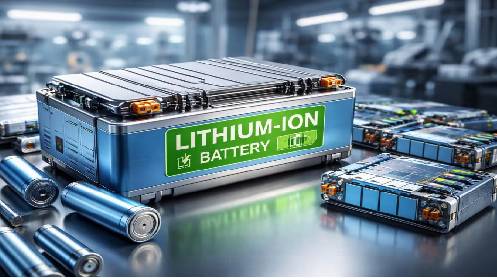
ISLAMABAD/KARACHI: Pakistan’s first lithium-ion battery manufacturing facility is set to become operational in Karachi’s Korangi Industrial Area, marking a major step toward developing a domestic energy storage industry as the National Lithium-Ion Battery Manufacturing Policy 2026–31 moves closer to approval.
According to stakeholders, the proposed plant will initially focus on producing lithium batteries for electric bikes, e-scooters, and electric vehicles, helping reduce reliance on imported battery systems.
The development was shared during a meeting chaired by Engineering Development Board (Engineering Development Board) Chief Executive Hammad Mansoor, who confirmed that the draft policy has been forwarded to the Ministry of Industries and Production and will subsequently be reviewed by the National Tariff Board. The plan includes reducing import duties on components required for local assembly and manufacturing of lithium batteries.
Following approvals, the policy will be submitted to the prime minister and cabinet, and later incorporated into Budget 2026–27.
Officials noted that the initiative aims to build a local battery ecosystem to support Pakistan’s growing demand for energy storage, particularly for solar systems and electric mobility, while reducing imports of completely built-up (CBU) battery units.
Currently, Pakistan relies heavily on imported lithium batteries for electric vehicles and backup power systems used in sensitive installations, including financial institutions. However, local industry players are now entering the sector, with engineering firm EV Technologies proposing a domestic lithium battery production facility.
EV Technologies CEO Huma Khattak stated that the manufacturing plant has already been ordered and is expected to begin production within two to three months, aligning with the anticipated rollout of the new policy framework.
The Korangi-based facility will initially have a capacity equivalent to 4 megawatts, enabling production of batteries sufficient for approximately 2,000 electric bikes and scooters per month.
Industry stakeholders believe the project signals an important shift toward localised clean energy manufacturing, supported by Pakistan’s increasing adoption of solar energy and electric mobility solutions across both domestic and commercial sectors.